AutomotivePrecision MachineryConfidential global industrial technology and turbocharger supplier program

Case Study

Controlling Hot-Rolled Stainless Sheet to ±0.05 mm for Turbocharger Precision Components

A confidential global industrial technology supplier program needed hot-rolled stainless sheet controlled to ±0.05 mm for turbocharger precision components.

Project Profile

Overview

Client Type
Confidential global industrial technology and turbocharger supplier program
Application
Tight-tolerance hot-rolled stainless sheet for turbocharger precision components
Service Scope
Coil selection, leveling-process control, on-site thickness measurement and ±0.05 mm tolerance sheet supply support

Measured Impact

Results Snapshot

Thickness Tolerance
±0.05mm

Hot-rolled stainless sheet thickness was controlled to an unusually tight tolerance range.

Leveling Success Rate
95+%

Stable success rate achieved through coil selection, inspection and process control.

Supply Model
Custom-selected

A low-volume, high-precision requirement was solved without relying on a standard mill custom batch.

Customer Challenge

Customer Challenge

The customer was a confidential global industrial technology and turbocharger supplier program. The project required hot-rolled stainless sheet for turbocharger precision components, with a thickness window much tighter than standard supply.

For this application, selecting the right coil alone was not enough. Material selection, head-and-tail control, leveling and on-site measurement all had to work together to avoid dimensional variation and surface-quality risk.

Technical Analysis

Supply Chain Analysis

The problem combined four constraints: no suitable standard tolerance, conflict between dimensional precision and forming performance, excessive machining cost if thicker sheet was used, and order volume below typical mill customization thresholds. This made the issue not only a procurement problem but also a production-readiness bottleneck for the customer’s component program.

Material Solution

Precision Selection Workflow

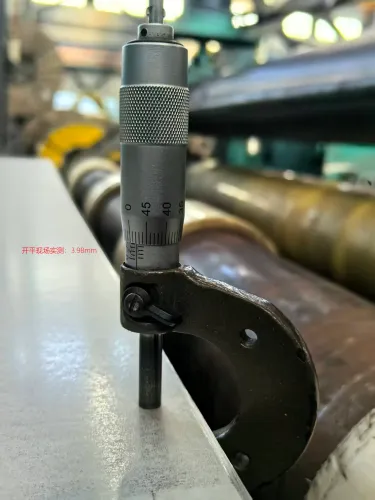
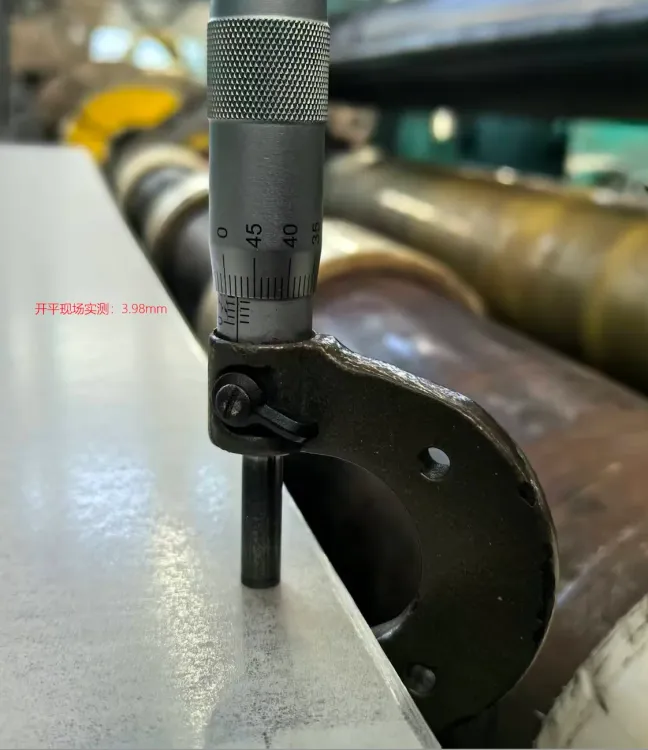
We extended supply-chain control into the coil selection and leveling process. Instead of asking the mill to change its rolling process, we worked with mill data and historical coil thickness distribution to predict which coils were most likely to meet the target range. During leveling, technicians monitored both sides of the line, carried out visual surface inspection and used micrometers for high-frequency grid-style thickness measurement.

Process Control

Quality Control Process

The workflow combined data prediction with hands-on inspection. Surface defects such as roll marks, scratches and remaining scale were filtered out, while thickness readings were recorded and fed back in real time. This created a micro-level quality gate inside a standard industrial process, turning ordinary hot-rolled coil into pre-selected, ready-to-use precision sheet.

Results

Results & Value Created

HydroPlatide controlled the route from original mill coil to final leveling: mill coil verification, strict removal of head and tail sections with poor surface quality, and multi-frequency on-site measurement during processing.

The final sheet maintained the required ±0.05 mm thickness control and created a repeatable supply basis for turbocharger precision components.

Key Insight

Case Insight

This case shows that the value of a specialist material partner often sits in the gap between upstream mill standards and downstream component requirements. Data can guide selection, but disciplined inspection and responsibility at the processing site are what convert a difficult non-standard requirement into a repeatable supply solution.

Project Gallery

Images

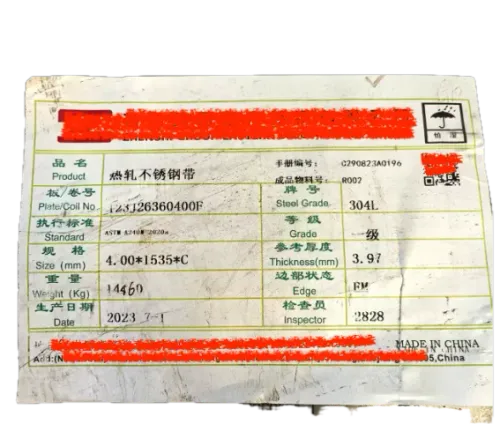
Original mill coil label for the hot-rolled stainless steel sheet supply
Original mill coil label from the major steel mill, used to verify the source coil before processing.
Strictly controlled stainless steel sheet material after removing defective head and tail sections
Strict material control removed head and tail sections with poor surface quality before final sheet preparation.
On-site multi-frequency thickness measurement during stainless steel sheet leveling
Multiple on-site measurements during the leveling process confirmed the required sheet thickness control.