
AutomotivePrecision MachineryConfidential EV automaker OEM program

Case Study

Protecting a Confidential EV Automaker OEM Deadline with 304 Stainless Steel Bright Bar Finished-Part Testing

A confidential leading EV automaker program needed urgent 304 bright bar validation through finished-part testing to protect an OEM launch deadline.

Project Profile

Overview

Client Type
Confidential EV automaker OEM program
Application
Finished-part validation for an automotive component
Service Scope
304 material review, bright bar supply, finished-part testing support and production approval support

Measured Impact

Results Snapshot

OEM Deadline Protected
1 program

Finished-part validation helped keep the OEM approval timeline moving.

Finished-Part Tests Passed
3/3

Chemical composition, tensile strength and elongation all passed on the finished part.

Urgent Validation Cycle
7 days

Machining, pre-test preparation and formal SGS testing were compressed into an urgent validation cycle.

Customer Challenge

Customer Challenge

Client identity is withheld for confidentiality. The project involved a leading EV automaker’s OEM production timeline.

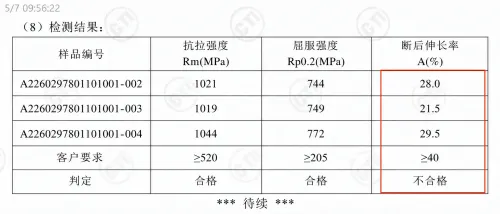
The customer was developing structural components machined from 304 stainless steel bright bar for an automotive program. Multiple rounds of sample parts failed qualification: some batches showed non-conforming chemical composition, while other batches failed mechanical property requirements. The repeated failures extended the project timeline significantly, and the customer was approaching the OEM program registration deadline with no qualified samples in hand.
Technical Analysis

Diagnosing a Validation Risk

When the customer reached us through a referral, they asked for something unusual: send the raw material itself out for third-party testing before machining. Digging deeper, we found the customer had been misled by a previous supplier into three connected misconceptions — that passing raw-material testing guarantees a conforming finished part, that machining can only degrade mechanical properties, and that raw-material testing alone is sufficient for qualification.

In reality, 304 stainless steel work-hardens during machining, and its final mechanical properties depend on the forming process and any post-machining heat treatment. Since the customer’s actual product is the machined part, only finished-part testing reflects true in-service performance.

Material Solution

HydroPlatide Response

We first corrected the customer’s testing approach: what ultimately goes into service is the machined part, not the raw material, so only finished-part testing can confirm real service performance.

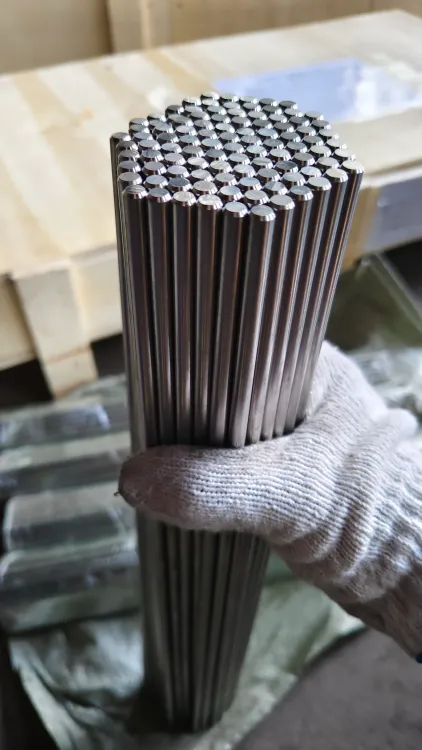
With the OEM qualification window closing, we ran a compressed emergency sampling program on new bar stock: machining, pre-test preparation and formal SGS testing on the finished parts, covering both chemical composition and tensile properties.

Validation

SGS Finished-Part Validation

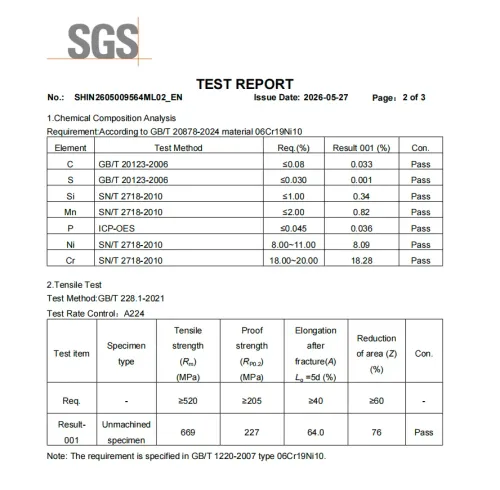
The SGS test report confirmed the finished parts passed all three required checks: chemical composition, tensile strength and elongation.

With the qualified report in hand, the customer placed an emergency order and we committed full production and logistics support to protect the OEM program delivery date.

Results

Results & Value Created

The finished parts passed SGS testing on both chemical composition and mechanical properties, the customer completed OEM program qualification within the registration window, and deliveries were phased to match the customer’s committed schedule.

Beyond the immediate order, the engagement corrected the customer’s quality-control approach going forward: raw-material testing and finished-part testing serve different purposes, and qualification should rely on both.

Key Insight

Case Insight

Raw-material testing passing does not guarantee a conforming finished part. Final acceptance has to be based on testing the part as it will actually be used in service.

In a confidential automotive program under OEM deadline pressure, the value was not only supplying 304 bright bar. It was helping the customer choose the right validation standard, obtain finished-part evidence and regain clarity before the launch timeline was affected.

Project Gallery

Images

Third-party CTI test report showing a previous supplier's stainless steel batch failing the elongation requirement, with results as low as 21.5% against a required 40% minimum
Previous supplier report: the batch failed the elongation requirement, creating risk for the confidential OEM program.
SGS test report for our 304 stainless steel material showing chemical composition and tensile properties all passing, including 64% elongation against a 40% minimum requirement
Our SGS report for the 304 material route: chemical composition and tensile properties passed for finished-part validation.